Neuromorphic Chips: The Brain-Inspired Hardware That Could Replace GPUs
Introduction
Training GPT-4 reportedly consumed around 50 gigawatt-hours of electricity, roughly the annual consumption of 4,500 US homes. Running it in production costs tens of millions of dollars per month in compute. The world's AI ambitions are scaling faster than the electrical grid can follow.
Meanwhile, the human brain processes information, recognises faces, understands language, and navigates physical environments, all while consuming approximately 20 watts. Less than a light bulb. No liquid cooling required.
This gap between megawatts for AI and watts for biology is the central motivation behind neuromorphic computing. Instead of adapting biological problems to silicon architectures, neuromorphic engineers ask a different question: what if the silicon itself worked more like a brain?
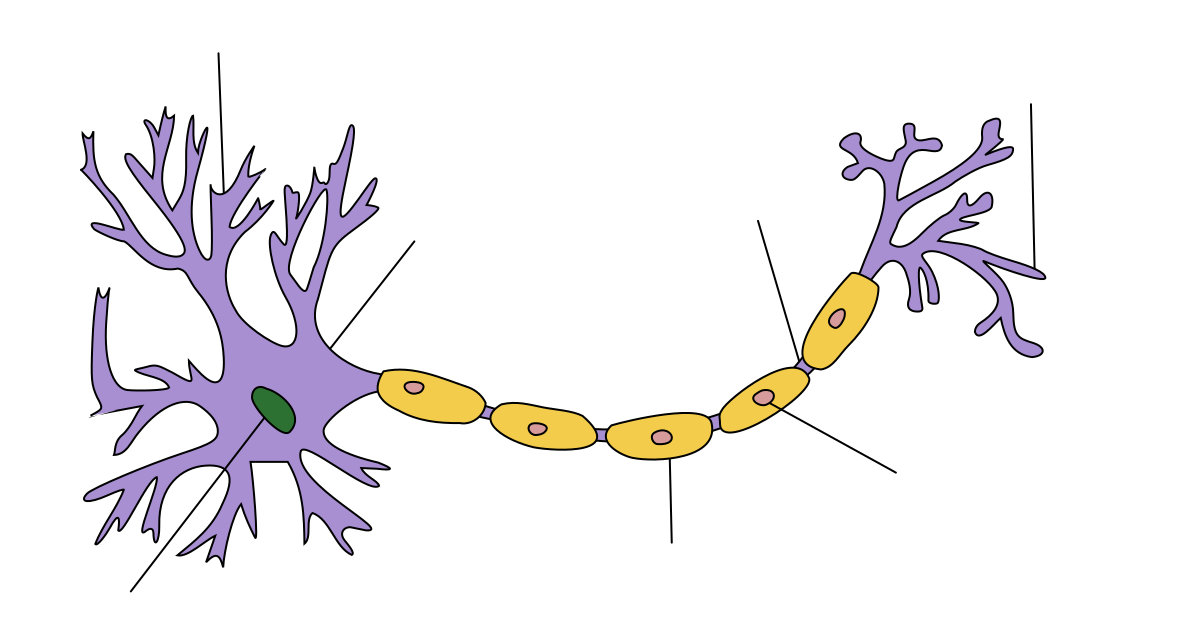
How the Brain Actually Computes
To understand what neuromorphic chips are trying to replicate, you need to understand what makes biological computation so radically different from conventional computing.
- Sparse, event-driven activation. A biological neuron only fires when its accumulated input exceeds a threshold. At any given moment, only about 1 to 5 percent of the brain's neurons are active. The rest consume almost no energy because they are idle, not clocking. A GPU, by contrast, runs every compute unit at full power every clock cycle, regardless of whether the computation is producing anything useful.
- In-memory computation. In the brain, memory and processing are co-located. Synapses store weights and perform computation at the same physical location. In conventional chips, memory and processor are separated, and data must be constantly shuttled between them. This "von Neumann bottleneck" is responsible for the majority of power consumption in modern AI accelerators, not the arithmetic itself.
- Spike-based communication. Neurons communicate by firing binary spikes. Either a signal propagates, or it does not. There are no floating-point numbers travelling between neurons. Information is encoded in the timing and frequency of spikes, not in their magnitude, which means communication is extremely low-bandwidth and energy-sparse.
- Local, online learning. Synaptic weights adapt continuously based on local activity through a process called spike-timing-dependent plasticity (STDP). There is no global loss function, no backpropagation pass, and no separate training phase distinct from inference. The network learns and runs simultaneously.
What Is a Neuromorphic Chip?
A neuromorphic chip is a processor designed to implement neuron-synapse dynamics directly in hardware. Rather than processing dense matrices of floating-point numbers as a GPU does, neuromorphic chips represent computation as networks of artificial neurons connected by artificial synapses. They process only when spikes arrive, consuming energy only for active neurons. Synaptic weights are stored in on-chip memory adjacent to the processing elements, eliminating data movement. The entire system operates asynchronously, without a global clock.
The result is a processor that is exceptionally energy-efficient for sparse, temporal, event-driven workloads, which describes a large class of real-world inference problems including sensor monitoring, keyword detection, and tactile feedback processing.
Spiking Neural Networks: The Software Side
Neuromorphic chips run Spiking Neural Networks (SNNs), a class of neural network where neurons communicate via discrete spikes rather than continuous-valued activations.
In a conventional artificial neural network (ANN), activation functions like ReLU output a real number that propagates through every layer at every forward pass. In an SNN, a neuron accumulates incoming spike signals in a quantity called the membrane potential. When this potential crosses a threshold, the neuron fires a spike to its downstream connections and resets back to its resting state. If the threshold is not crossed, nothing is transmitted and no energy is consumed.
Information is encoded in the rate at which a neuron fires, or in the precise timing of when it fires, rather than in a continuous number. This makes SNNs naturally suited to processing time-series data like audio streams, video frames, and physical sensor signals where events unfold over time.
The main challenge with SNNs is that the spike operation is not differentiable, which means standard backpropagation cannot be applied directly. Researchers use two workarounds: surrogate gradient methods, which approximate the derivative of the spike function during the backward pass, and ANN-to-SNN conversion, where a conventional deep network is trained first and then its weights are transferred to an equivalent SNN architecture.
Code Example: Simulating a Spiking Neuron
The most fundamental model in neuromorphic computing is the Leaky Integrate-and-Fire (LIF) neuron. This is the model that Intel Loihi and IBM TrueNorth implement in hardware. Understanding it in code makes the hardware design much clearer.
import numpy as np

# Leaky Integrate-and-Fire (LIF) neuron simulation
# This is the core computation that neuromorphic chips implement in silicon

dt = 0.1           # time step in milliseconds
T = 100.0          # total simulation time (ms)
tau_m = 20.0       # membrane time constant (ms) — how fast voltage decays
V_rest = -70.0     # resting membrane potential (mV)
V_thresh = -50.0   # spike threshold (mV)
V_reset = -70.0    # post-spike reset potential (mV)

time = np.arange(0, T, dt)
V = np.full_like(time, V_rest)
spike_times = []

# Simulate noisy synaptic input that starts at t=20ms
np.random.seed(42)
I_input = np.where(time > 20, 22.0 + np.random.randn(len(time)) * 3.0, 0.0)

for t in range(1, len(time)):
    # Membrane equation: leak toward rest + integrate input current
    dV = (-(V[t-1] - V_rest) + I_input[t]) / tau_m * dt
    V[t] = V[t-1] + dV

    if V[t] >= V_thresh:         # threshold crossing = spike
        spike_times.append(time[t])
        V[t] = V_reset           # reset membrane after firing

print(f"Spikes fired:      {len(spike_times)}")
print(f"Average fire rate: {len(spike_times) / (T / 1000):.1f} Hz")
print(f"First spike at:    {spike_times[0]:.1f} ms" if spike_times else "No spikes")
The key insight from this code is that the neuron only "does work" when it fires (the
if V[t] >= V_thresh branch). Between spikes, it simply leaks back toward rest.
When you implement this logic in hardware instead of software, and wire thousands of such
neurons together on a chip, the energy consumption drops dramatically because most neurons
are idle at any given moment.
The Major Neuromorphic Chips: A Comparison
| Chip | Organisation | Neurons | Synapses | Key Characteristics | Status |
|---|---|---|---|---|---|
| Loihi 2 | Intel | 1 million | 120 million | On-chip learning, programmable neuron models, 10× more efficient than Loihi 1 | Research access via Intel Neuromorphic Research Community |
| Hala Point | Intel | 1.15 billion | ~128 billion | 1,152 Loihi 2 chips integrated; largest neuromorphic system to date (2024) | Deployed at Sandia National Laboratories |
| TrueNorth | IBM | 1 million | 256 million | Runs at 70mW for 1 million neurons; no on-chip learning; fixed neuron model | Research; limited commercial deployment |
| SpiNNaker 2 | University of Manchester / TU Dresden | ~152,000 per chip (system-level: ~150–180 million) | Configurable | General-purpose ARM cores paired with neuromorphic fabric; flexible programming model | EU Human Brain Project; research access |
| Akida | BrainChip | 1.2 million | ~10 billion | Designed for edge deployment; on-chip learning; accepts standard ML model formats | Commercial (development kits available) |
Intel Loihi 2: A Closer Look
Intel's Loihi 2 is the most widely researched neuromorphic chip in academic and industrial labs outside of IBM. Released in 2021 and built on Intel's 4nm process node, it contains 1 million programmable neurons and 120 million synapses on a single die.
What distinguishes Loihi 2 from its predecessor and from IBM TrueNorth is its ability to perform on-chip learning. Synaptic weights can be updated during operation using spike-timing-dependent plasticity rules, without sending data off-chip to an external processor. This enables systems that genuinely adapt in real time to new inputs, which is something that conventional inference hardware cannot do without a separate training pass.
Intel has demonstrated three particularly notable applications on Loihi 2. The first is robotic touch sensing, where the chip processes signals from neuromorphic tactile sensors that mimic fingertip mechanoreceptors with 1,000 times lower latency and 10,000 times lower energy than a GPU-based equivalent. The second is olfaction: classifying gas mixtures in real time using spike patterns from chemical sensors, completing each classification in milliseconds at microwatt power levels. The third is combinatorial optimisation, where NP-hard constraint problems like graph colouring and scheduling are mapped onto the chip's topology and solved by the natural dynamics of the spiking network converging toward equilibrium.
Energy Comparison: Neuromorphic vs Conventional
The energy advantage of neuromorphic chips is most pronounced on sparse, event-driven workloads. On dense matrix operations, which are the foundation of transformer inference, conventional accelerators still win because they were specifically designed for that workload.
| Task | Hardware | Approx. Energy per Inference | Notes |
|---|---|---|---|
| Image classification (ResNet-20) | NVIDIA A100 GPU | ~2,000 µJ | Dense activations; GPU is underutilised at batch size 1 |
| Same task converted to SNN | Intel Loihi | ~7 µJ | Approximately 300 times more efficient; accuracy is slightly lower |
| Keyword spotting (always-on) | ARM Cortex-M CPU | ~200 µJ per word | Standard approach for current smart speakers and microcontrollers |
| Same task on neuromorphic | BrainChip Akida | Low single-digit µJ per word | Orders of magnitude more efficient; enables genuine battery-powered always-on listening |
The energy savings compound significantly when the task requires continuous, always-on operation such as monitoring a sensor stream, listening for a wake word, or processing camera frames at the edge. A GPU needs to remain powered continuously even when nothing is happening. A neuromorphic chip consumes energy only when spikes arrive, which means it can sit in near-zero-power standby indefinitely and wake only when there is signal to process.
Applications in Production Today
Neuromorphic computing is not science fiction. It is being used in narrow but commercially real applications right now, and several research demonstrations are approaching production readiness.
Edge keyword detection is the most mature commercial use case. BrainChip's Akida chip is deployed in smart home devices for always-on wake word detection. The key benefit over ARM-based microcontrollers is not just energy efficiency but the ability to do on-device learning: users can add new wake words without sending data to the cloud, which addresses both privacy and latency concerns. Akida's development kit runs keyword spotting in the low single-digit microjoule range per word, meaning a small coin cell battery can theoretically power months of continuous listening.
Prosthetics and tactile feedback represent one of the most compelling research applications. Researchers at Johns Hopkins Applied Physics Lab use neuromorphic chips to process signals from implanted electrodes in amputees' residual limbs. The goal is to decode nerve signals and translate them into motor commands for prosthetic hands, while simultaneously sending tactile feedback signals back in the other direction. The millisecond-level latency requirement for natural-feeling touch feedback is exactly what neuromorphic processing can provide, since conventional CPUs introduce too much delay.
Space and satellite applications are an active evaluation area for NASA and ESA. Satellites must process sensor data locally because transmitting everything to Earth is bandwidth-limited and introduces minutes of latency. Neuromorphic chips are attractive because they can run continuously on the limited power available from solar panels, survive radiation exposure better than conventional CMOS designs, and process event-based sensor data in real time. NASA has already placed a Loihi chip aboard a nanosatellite (TechEdSat-13, launched January 2022) as the first neuromorphic processor deployed in orbit.
Neuromorphic vision sensors are a complementary hardware development that pairs naturally with neuromorphic chips. Event cameras (also called dynamic vision sensors or DVS cameras) do not capture frames at a fixed frame rate. Instead, each pixel fires independently whenever its local brightness changes, outputting a continuous stream of events with microsecond timestamps. This is exactly the kind of sparse, asynchronous, event-driven data that neuromorphic chips are designed to process efficiently. Event cameras from Prophesee and Sony are already used in industrial inspection and high-speed robotics.
Why Neuromorphic Chips Have Not Taken Over
Given the energy advantages, why is every AI lab not running on Loihi 2? Several structural barriers prevent mainstream adoption, and they are worth understanding honestly.
The programming model is fundamentally different from anything in the conventional ML stack. Writing code for neuromorphic hardware requires thinking in spikes and timing, not tensors and gradients. There is no PyTorch equivalent for SNNs that reaches the same usability threshold. Intel's Lava framework and the SpikingJelly library for Python have made progress, but neither has the maturity, documentation quality, or ecosystem of CUDA.
Training deep SNNs from scratch remains an open research problem. Surrogate gradient methods work in limited settings but consistently underperform conventional deep learning at scale. ANN-to-SNN conversion avoids this problem but typically requires many more inference timesteps to accumulate the rate-coded information, eroding some of the energy advantage.
The energy advantage is also task-specific. It is largest for sparse, temporal, event-driven data. Dense transformer inference, which powers most of today's commercially valuable AI applications, does not benefit much because attention is inherently dense, and there are few idle neurons to exploit. For the tasks where GPUs currently dominate, neuromorphic hardware offers no compelling advantage today.
Finally, the ecosystem is fragmented. Each chip has its own SDK. Code written for Loihi does not run on Akida, and neither works with the SpiNNaker API. Without a universal abstraction layer, developers face steep reinvestment costs every time they switch hardware, which suppresses experimentation and delays the community learning that accelerates software maturity.
The Path Forward
Intel's Hala Point system, which integrates 1,152 Loihi 2 chips into a single research system with 1.15 billion neurons, was deployed at Sandia National Laboratories in 2024. Intel describes it as the world's largest neuromorphic computer, and it represents a genuine inflection in scale. At brain-scale neuron counts, it becomes possible to study whether the energy and latency advantages hold up for tasks that are currently too complex for smaller systems.
The most likely near-term trajectory for neuromorphic computing in commercial products is hybrid architectures. A neuromorphic co-processor handles sparse, temporal preprocessing tasks like sensor fusion, event detection, and always-on monitoring. A conventional GPU or NPU handles the dense computation required by transformer models when a complex response is needed. Modern smartphones already demonstrate this division of labour: the always-on "neural engine" or dedicated wakeword chip consumes microwatts, while the main GPU powers up only when the user actively makes a request.
Longer term, analog neuromorphic computing promises even greater efficiency. In analog designs, the physical behaviour of the transistor or memory device directly implements synaptic dynamics, rather than computing them digitally. IBM's research in phase-change memory and Intel's work with resistive RAM implement synaptic weights as physical conductances that change when current flows through them. These approaches could reduce energy consumption by further orders of magnitude for edge inference, though they introduce new challenges around device variability and read noise.
Key Takeaways
- The brain runs on 20 watts by computing only when needed. Neuromorphic chips replicate this event-driven, sparse efficiency in silicon and achieve 100 to 1,000 times better energy efficiency than GPUs on the right workloads.
- Intel Loihi 2 and IBM TrueNorth are the most mature research platforms. BrainChip Akida is the only commercially deployed option as of 2026, used primarily for edge keyword detection.
- Training SNNs from scratch is harder than training conventional ANNs. The lack of a differentiable spike function means backpropagation cannot be applied directly, and surrogate gradient methods have not yet matched ANN performance at scale.
- The energy advantage is task-specific. Dense transformer inference does not benefit, but always-on edge tasks like sensor monitoring and keyword detection show dramatic efficiency gains.
- The most realistic near-term outcome is hybrid architectures pairing neuromorphic edge processors with conventional AI accelerators, not a wholesale replacement of GPUs.
References
- Davies, M., et al. (2018). Loihi: A Neuromorphic Manycore Processor with On-Chip Learning. IEEE Micro, 38(1).
- Davies, M., et al. (2021). Advancing Neuromorphic Computing With Loihi: A Survey of Results and Outlook. Proceedings of the IEEE, 109(5).
- Merolla, P.A., et al. (2014). A Million Spiking-Neuron Integrated Circuit with a Scalable Communication Network. Science, 345(6197).
- Mahowald, M., & Douglas, R. (1991). A Silicon Neuron. Nature, 354.
- Schuman, C.D., et al. (2022). Opportunities for Neuromorphic Computing Algorithms and Applications. Nature Computational Science, 2.
- Gallego, G., et al. (2022). Event-Based Vision: A Survey. IEEE TPAMI, 44(1).